


Start Date
4-29-2025 10:45 AM
Description
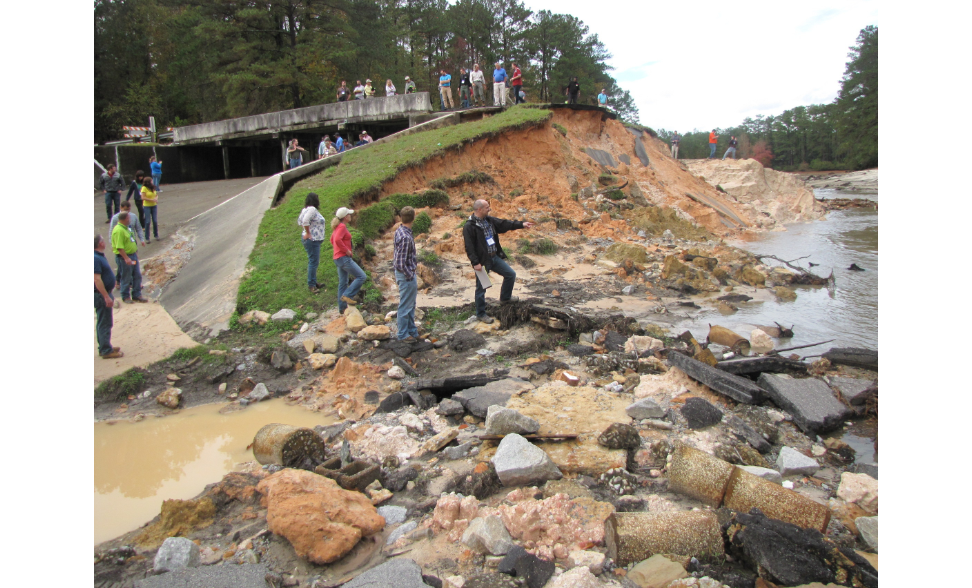
Dam and embankment failures can have devastating consequences for communities, infrastructure, and the environment. Therefore, accurate modelling of dam and embankment breaches is crucial for effective flood risk assessment and emergency response planning to precisely estimate areas and people that are prone to risk and plan for reducing the damage to properties and the environment. Recently, many advances have been made to improve the accuracy of breach modelling, including the development of physically based one and two dimensional numerical models that takes into account the various processes that take place during the breach of an embankment dam or a flood embankment.
This paper presents the recent work that was undertaken at HR Wallingford to further improve the various breach modelling aspects by exploring the possibilities of using Computational Fluid Dynamics (CFD) models to simulate a breach. Although commercial CFD packages exist that can model air-water interaction well, there are none that currently model air-water-soil erosion at a suitable scale. Therefore, this work started by looking first at potential CFD core methods that can be used such as CFD with Discrete Element Method (CFD-DEM), Smoothed Particle Hydrodynamics Discrete Element Method (SPH-DEM), and Material Point Method (MPM) with a focus on their capabilities to simulate the complex breach processes. Example cases of using CFD-DEM are presented showing the challenges in setting up CFD models, selecting the various parameters required for such models and computational power needed to run a simulation. Based upon that, a number of near future and long-term recommendations for the use of CFD for breach modelling are made to contribute to the development of more accurate and reliable tools for assessing the potential impacts of dam and embankment failures.
Included in
Can Computational Fluid Dynamics be the Basis for the Next Generation of Breach models?
Dam and embankment failures can have devastating consequences for communities, infrastructure, and the environment. Therefore, accurate modelling of dam and embankment breaches is crucial for effective flood risk assessment and emergency response planning to precisely estimate areas and people that are prone to risk and plan for reducing the damage to properties and the environment. Recently, many advances have been made to improve the accuracy of breach modelling, including the development of physically based one and two dimensional numerical models that takes into account the various processes that take place during the breach of an embankment dam or a flood embankment.
This paper presents the recent work that was undertaken at HR Wallingford to further improve the various breach modelling aspects by exploring the possibilities of using Computational Fluid Dynamics (CFD) models to simulate a breach. Although commercial CFD packages exist that can model air-water interaction well, there are none that currently model air-water-soil erosion at a suitable scale. Therefore, this work started by looking first at potential CFD core methods that can be used such as CFD with Discrete Element Method (CFD-DEM), Smoothed Particle Hydrodynamics Discrete Element Method (SPH-DEM), and Material Point Method (MPM) with a focus on their capabilities to simulate the complex breach processes. Example cases of using CFD-DEM are presented showing the challenges in setting up CFD models, selecting the various parameters required for such models and computational power needed to run a simulation. Based upon that, a number of near future and long-term recommendations for the use of CFD for breach modelling are made to contribute to the development of more accurate and reliable tools for assessing the potential impacts of dam and embankment failures.